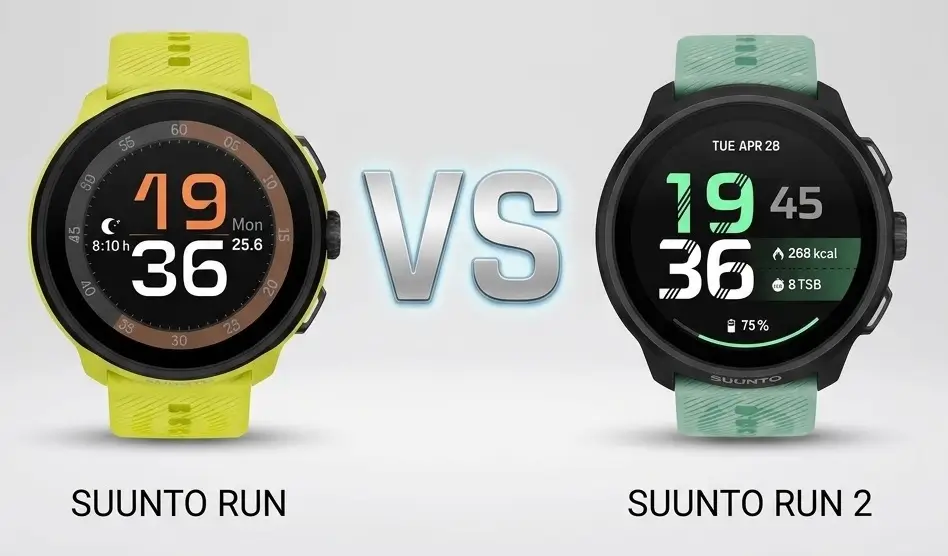
When Suunto launched the original Suunto Run, it hit a sweet spot for road runners who wanted a simple, lightweight sports watch with a clear screen and clean stats. But running tech moves fast.
With the launch of the Suunto Run 2, Suunto did not just make a small update. They kept the ultra-light 35-gram body, but fixed nearly every limitation of the first generation.
Here is a simple, detailed look at how the Suunto Run 2 compares to the original Suunto Run, and what these changes mean for your daily runs.
Complete Side-by-Side Specifications Comparison
| Feature / Spec | Original Suunto Run | Suunto Run 2 |
| Launch Price | $249 USD / £219 GBP |
4GB: $349 USD / £265 GBP 64GB: $399 USD / £299 GBP |
| Internal Storage | 4 GB | 4 GB or 64 GB (depending on version) |
| Weight (Body) | 36 grams | 35 grams |
| Display Type | 1.32-inch AMOLED | 1.32-inch LTPS AMOLED |
| Display Brightness | 600 nits | 2,000 nits (Peak) |
| Offline Maps | No (Breadcrumb routes only) | Yes (Free Worldwide Offline Maps) |
| Battery Capacity | 295 mAh | 380 mAh (+29% increase) |
| GPS Battery Life | Up to 20 hours (Performance Dual-Band) | Up to 24 hours (Performance Dual-Band) |
| Daily Battery Life | Up to 8 days | Up to 10 days |
| Heart Rate Sensor | Previous Gen Optical | New 12-Channel Optical Sensor (Curved Glass) |
| GPS System | Dual-Band (L1 + L5) | Upgraded Dual-Band (L1 + L5, 5 Satellite Systems) |
| Water Resistance | 50m (5 ATM) | 50m (5 ATM) |
Screen and Visibility: No More Squinting in the Sun

The biggest visual change on the Suunto Run 2 is its screen:
-
Original Suunto Run: 1.32-inch AMOLED screen with 600 nits brightness.
-
Suunto Run 2: 1.32-inch AMOLED screen with 2,000 nits peak brightness.
The original watch was sharp indoors, but during bright midday runs, reading your live pace could require shading the screen with your hand. The Run 2 jumps to 2,000 nits of peak brightness—three times brighter than the original. Numbers stay crisp and easy to read at a glance, even in full summer sunlight or while swinging your arms at high speeds.
Maps and Navigation: A Major Upgrade
The biggest functional difference between these two generations comes down to navigation:
-
Original Suunto Run: Offered basic breadcrumb routing without built-in maps.
-
Suunto Run 2: Features free worldwide offline maps stored directly on the watch.
You can download map regions over Wi-Fi, view full street layouts, and navigate trails or new city routes straight from your wrist without taking your phone. Storage capacity has also expanded (up to 64GB on premium versions), giving you room for maps alongside offline music and podcasts.
Sensors: Better GPS and Heart Rate Accuracy
Running watches are only as good as the data they give you. Suunto updated both primary sensors on the Run 2:
1. New-Generation Dual-Band GNSS: While the original Run had dual-band GPS, the Run 2 moves to a newer hardware chipset tracking L1 and L5 signals across five major satellite systems (GPS, GLONASS, Galileo, BeiDou, and QZSS). This prevents signal drift between tall city buildings, under thick tree cover, or around mountains.
2. Redesigned 12-Channel Heart Rate Sensor: The original model used an older sensor array that could lag during rapid heart rate changes. The Run 2 features a new 12-channel optical heart rate sensor set behind 2.5D curved glass. The curved shape sits closer against the skin, reducing light leakage and tracking sudden heart rate spikes during hard track intervals or hill sprints much faster.
Battery Life: More Power in the Same Size
Despite keeping the exact same 35-gram casing weight and slim profile, Suunto increased the internal battery capacity by 29 percent (up from 295 mAh to 380 mAh).
-
Original Suunto Run: 295 mAh battery — 8 days in daily smartwatch mode, 20 hours in full GPS mode.
-
Suunto Run 2: 380 mAh battery — 10 days in daily smartwatch mode, 24 hours in full GPS mode.
An extra 4 hours of full dual-band GPS tracking means the watch will easily cover a full marathon or a week of training on a single charge.
New Software Features: Real-Time Run Insights
The Run 2 introduces EnergySense and upgraded real-time marathon pacing. Instead of showing simple averages, EnergySense evaluates your current pace, heart rate variation, and elevation to tell you live how much stamina you have left in the tank. On race day, the watch dynamically updates your estimated marathon finish time based on how you handle hills and pacing in real time.
Which One Should You Pick?
If you already own the original Suunto Run and mostly stick to known neighborhood tracks, it remains a light, comfortable watch.
However, the Suunto Run 2 acts like a mini flagship device. With full offline mapping, a screen that cuts through direct sunlight, better heart rate accuracy on interval days, and a longer-lasting battery, it offers upgrades you feel on almost every run.
You May Also Like To Check Out: The New and Latest Smartwatches 2026